

Multiple lithium aquifers and well-established infrastructure.
— OUR FLAGSHIP PROJECT
The Peace River Project sits inside one of the most extensively developed hydrocarbon corridors in western Canada.
— PEACE RIVER PROJECT
One of Canada’s Largest Lithium Brine Assets
Located in the heart of one of Alberta’s oil and gas corridors.
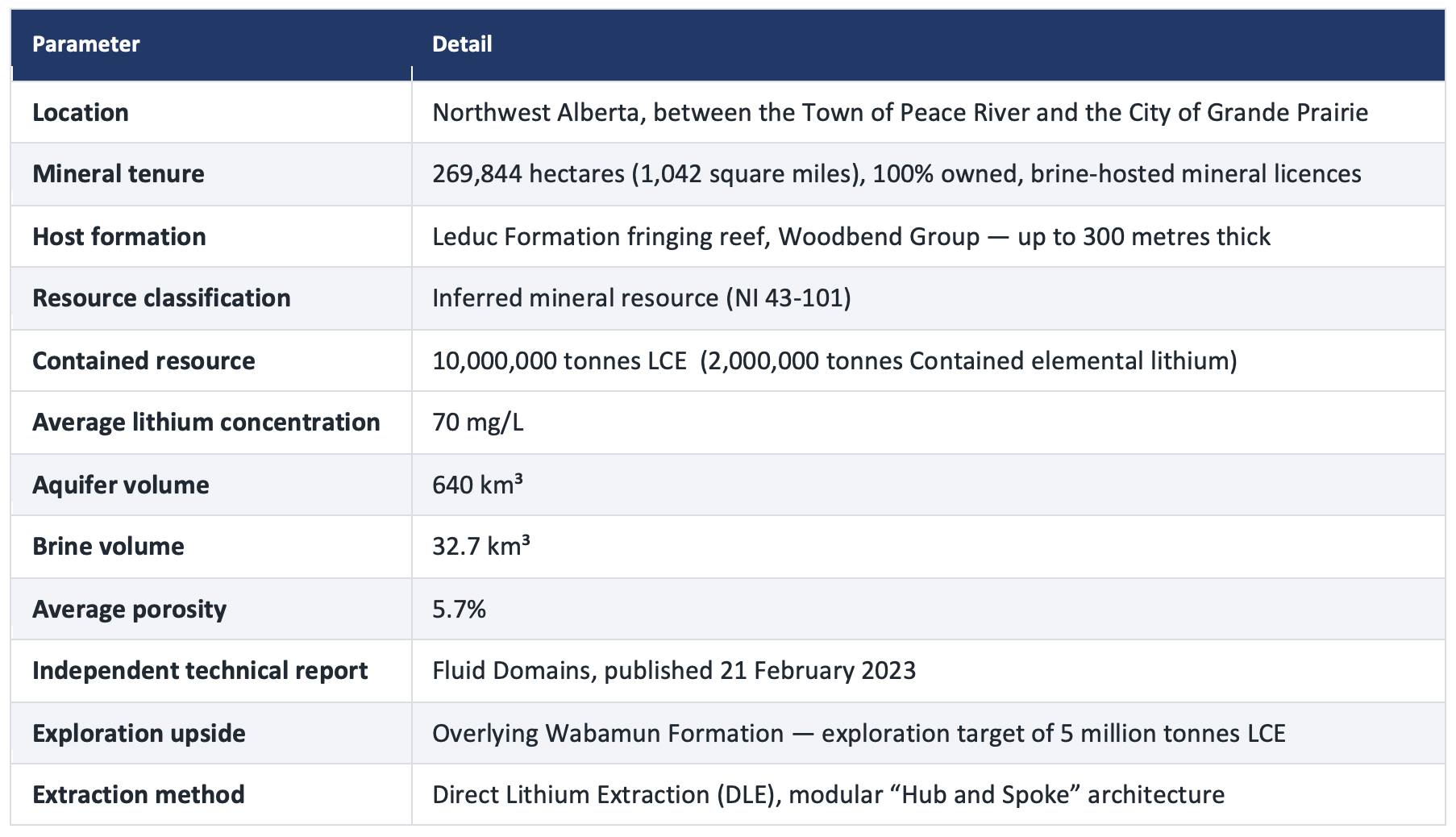
The Peace River Lithium Project is NeoLithica’s flagship asset, situated in northwest Alberta between the Town of Peace River to the north and the City of Grande Prairie to the south. It comprises 269,844 hectares — 1,042 square miles — of contiguous, one-hundred-per-cent-owned brine-hosted mineral tenure over a Leduc Formation fringing-reef complex reaching 300 metres in thickness.
An independent NI 43-101 Technical Resource Report prepared by Fluid Domains and published on 21 February 2023 estimated an inferred mineral resource of 10 million tonnes of lithium carbonate equivalent (LCE) within the Leduc Formation, at an average lithium concentration of 70 mg/L. On that basis, Peace River is one of the largest single lithium resource projects in Alberta and one of the largest licence positions among NeoLithica’s direct North American peer group.
What distinguishes the Project is not scale alone. It sits inside one of the most extensively developed hydrocarbon corridors in western Canada, where the roads, rail, electrical power, well sites, pipelines and technical workforce a lithium development needs were built over decades to serve a mature oil and gas industry — rather than having to be constructed from nothing.
— PROJECT AT A GLANCE
— THE RESOURCE
A resource defined by independent technical work
The Leduc Formation resource at Peace River was defined under National Instrument 43-101, the Canadian standard for public disclosure of mineral projects. It is classified as an inferred mineral resource — the earliest of the three resource confidence categories. NeoLithica’s 2027–2028 development programme is designed to continue to de-risk the project.
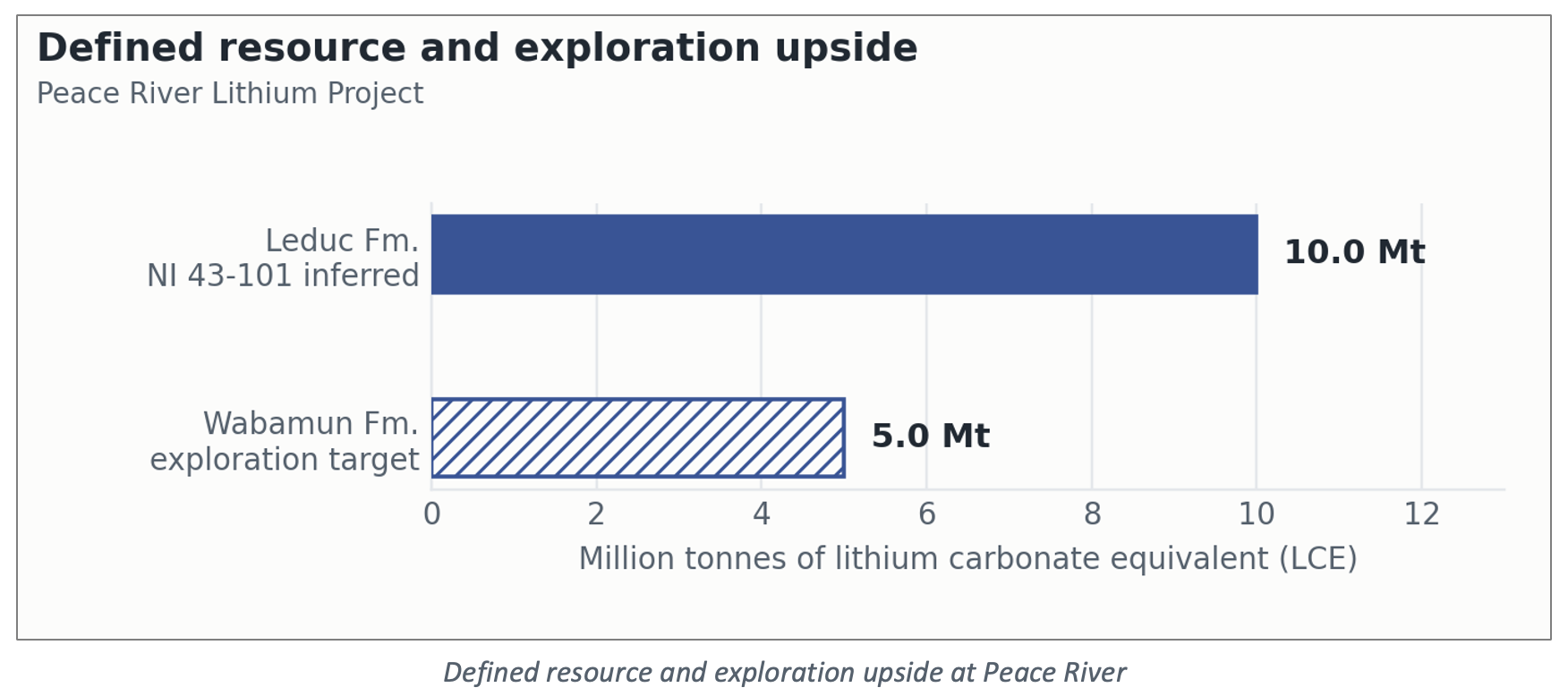
Beyond the defined resource, NeoLithica has identified meaningful exploration upside in the overlying Wabamun Formation, with the potential for a further 5 million tonnes of LCE within the existing land position. Because that upside sits inside tenure the Company already holds, it offers a pathway to grow the resource base without acquiring new ground.
— GEOLOGY
Why the lithium is here
The lithium enrichment at Peace River traces back to the Peace River Arch, an ancient zone of structural disturbance in west-central Alberta that formed between Precambrian and Early Carboniferous time. The eastern portion of the arch is characterised by large-scale grabens and half-grabens oriented both parallel and normal to the arch axis. Erosion of the arch before its inundation in the Late Devonian generated layers of immature siliciclastics at its periphery, and those permeable clastic wedges became the pathways along which silicate materials and lithium-bearing fluids migrated into the surrounding Devonian aquifers.
The stacking of the Wabamun, Leduc, Swan Hills and Granite Wash reservoirs in close proximity to the arch makes northwest Alberta one of the most prospective areas in the province for lithium and associated minerals. NeoLithica’s tenure sits directly over highly porous and permeable Devonian-age carbonate buildups roughly 2,000 metres below surface, in the Wabamun and Leduc Formations of the Woodbend Group.
Four decades of public geological data
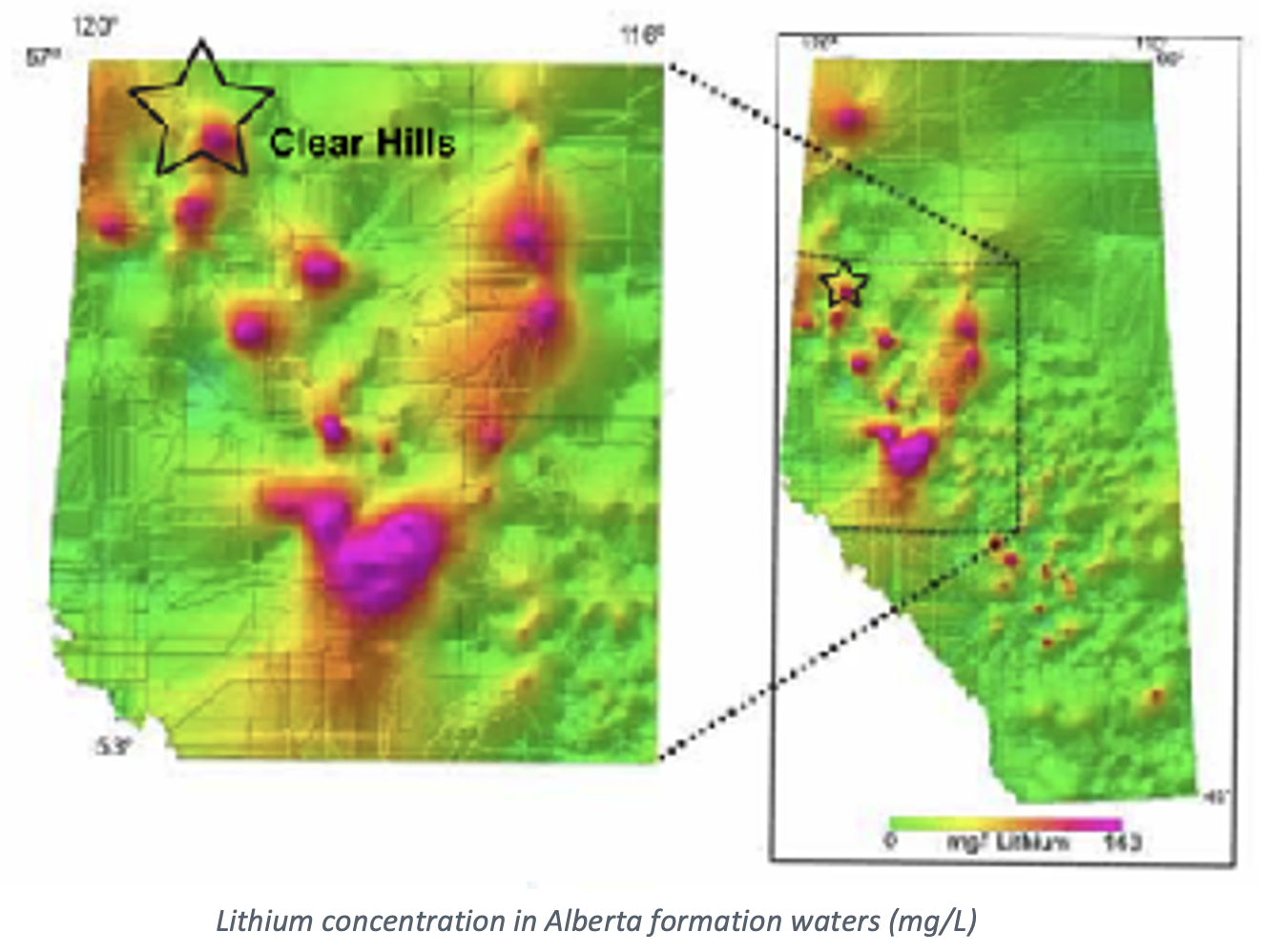
Alberta’s lithium potential is not a recent discovery. The Alberta Geological Survey identified high concentrations of lithium in saline formation waters associated with oil and gas reservoirs in the 1990s. Of roughly 130,000 formation-water analyses examined, 1,511 reported lithium. Within those:
98 analyses returned lithium concentrations above the typical background value of 50 ppm
48 analyses returned lithium concentrations above 75 ppm
The highest concentrations occurred in the Devonian-age Beaverhill Lake (Swan Hills) and Woodbend (Leduc) aquifers, at 130 mg/L and 140 mg/L respectively
Subsequent modelling identified areas of significant lithium resource including the northern Alberta Devonian reefs that underlie NeoLithica’s lands. The Alberta Energy Regulator and Alberta Geological Survey estimate that Alberta’s subsurface contains approximately 82.5 million tonnes of lithium carbonate equivalent in place.
— EXTRACTION VALIDATED
Extraction validated at pilot scale
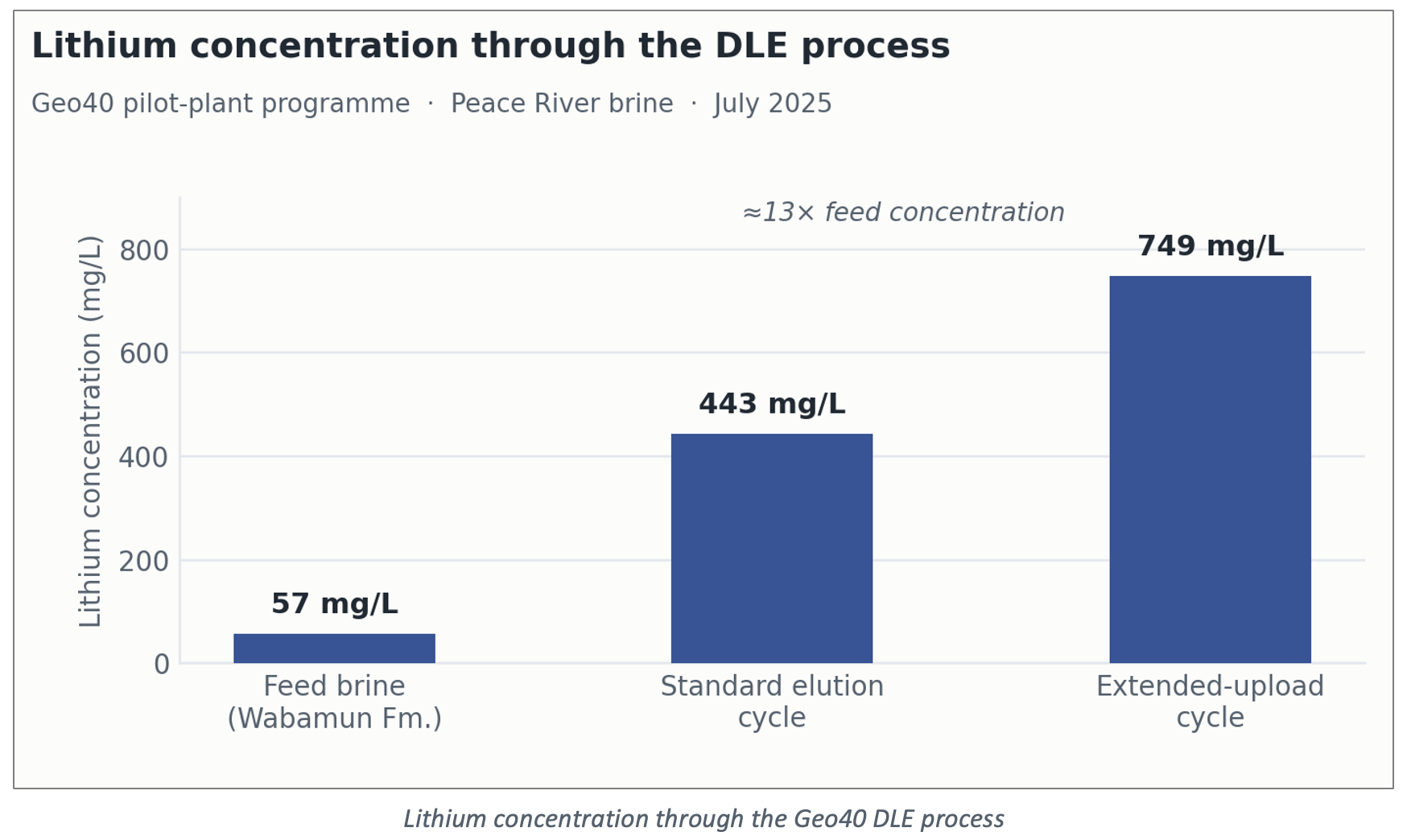
In July 2025, Geo40 Limited completed an independent pilot-plant programme on 6,000 litres of Wabamun Formation brine transported from the Peace River project area to a facility in Estevan, Saskatchewan. The brine was processed through 18 Direct Lithium Extraction cycles using Geo40’s proprietary Geosieve sorbent.
The programme achieved an average lithium recovery of 97%, with elution efficiency averaging 99%. A modified extended-upload cycle raised eluate concentration from 443 mg/L to 749 mg/L — roughly thirteen times the 57 mg/L feed brine — while also improving sorbent working capacity.
Critically, Geo40 carried the process through to finished product, precipitating a battery-grade lithium carbonate sample that measured greater than 99.9% purity against Albemarle and SQM commercial specifications. This matters because recovery rates alone do not establish commercial viability — the test that counts is whether the brine yields a product a battery manufacturer will actually buy.
Geo40 pilot programme results
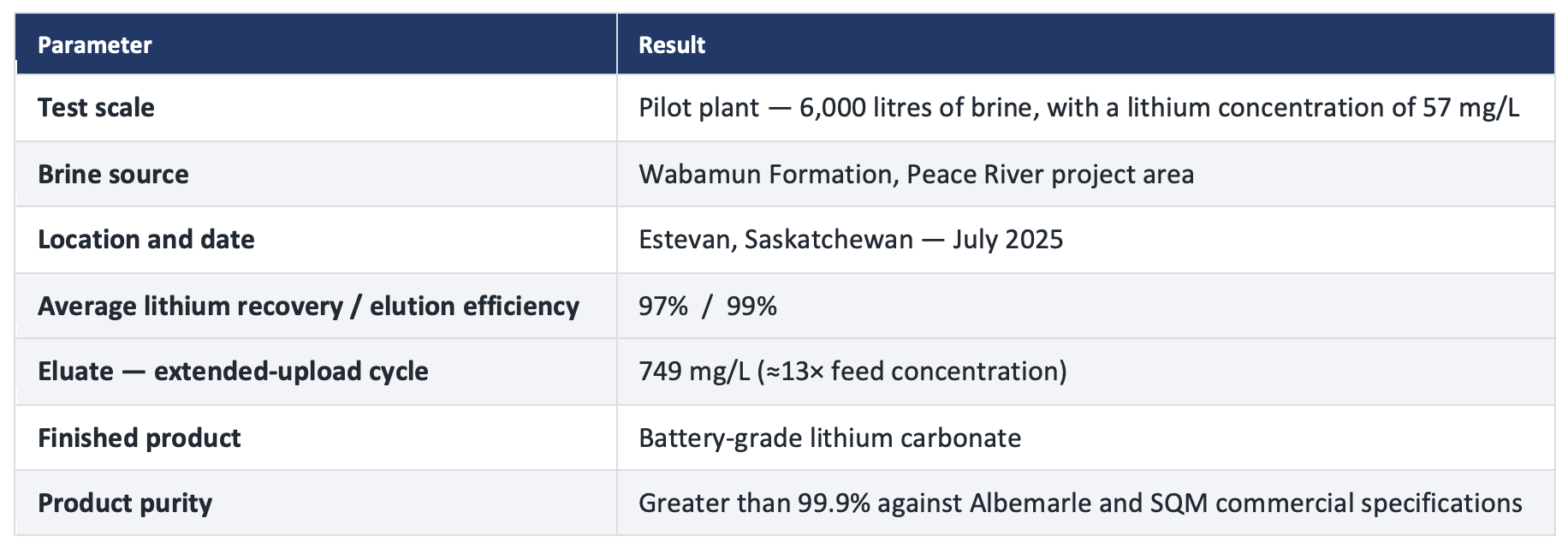
The Geo40 programme is one of two brine-specific validations NeoLithica has commissioned. Candle Lithium Corporation completed a parallel bench-scale programme on Leduc Formation brine from the Company’s Redwater Lithium Project, achieving up to 100% extraction in semi-batch mode and 95.6% in continuous mode. Running two vendors on two chemically distinct brines gives NeoLithica a genuine comparative basis on extraction efficiency, concentration factor, reagent and sorbent consumption, and tolerance to the hydrogen sulphide and organics present in oilfield-associated brine. The Company expects to select its prime commercial DLE technology partner in 2027.
— DEVELOPMENT MODEL
A modular development model
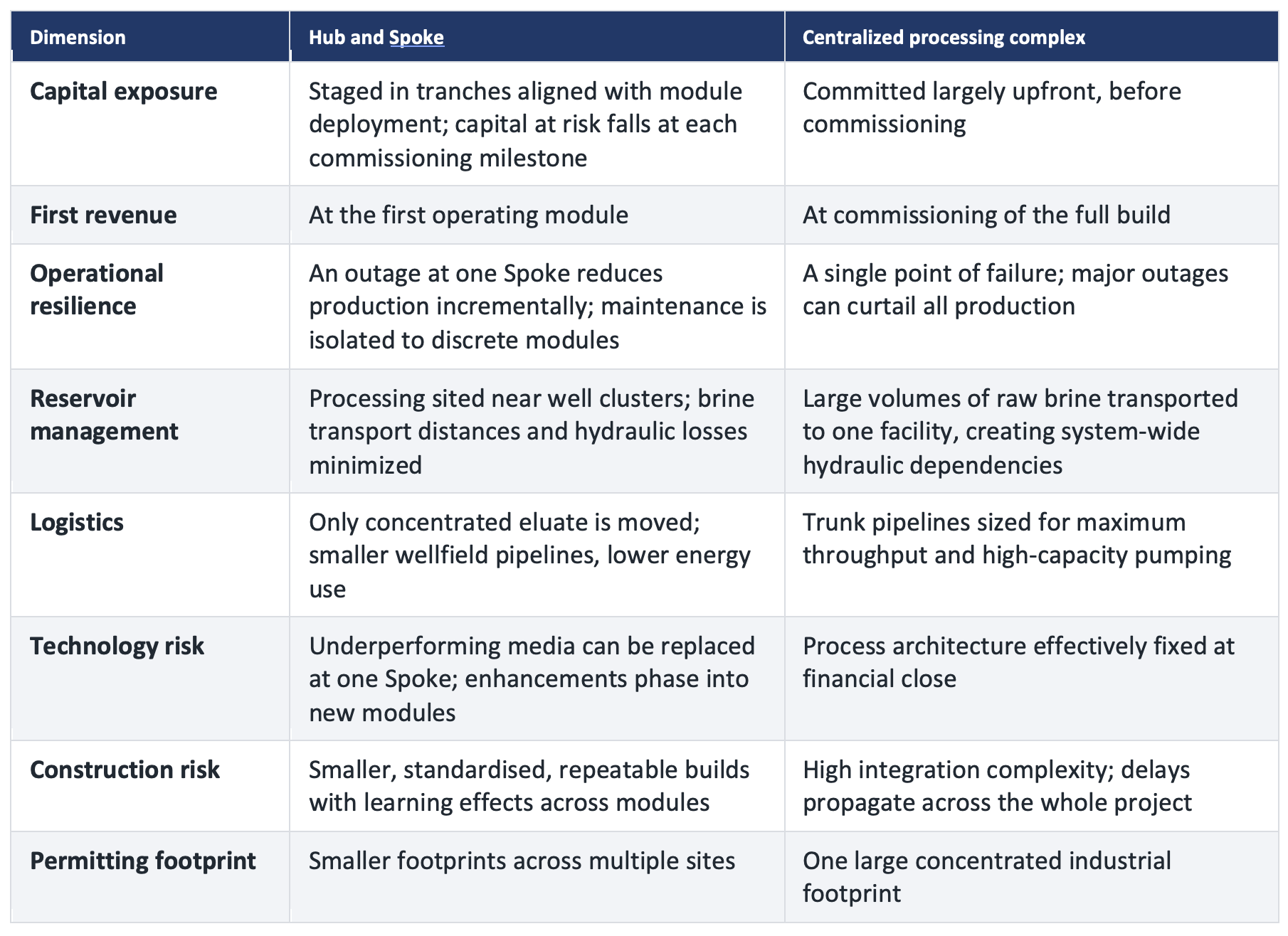
Conventional lithium-brine projects rely on a Centralized Processing Complex: a single large facility that performs adsorption, elution, purification, crystallisation and finishing in one footprint. That design requires most of the production wells, gathering systems and process units to be completed before any meaningful revenue arrives, which concentrates both capital and execution risk in a single event.
NeoLithica has instead designed a modular Hub and Spoke architecture. Approximately twenty modular DLE plants — the Spokes, each of roughly 2,000 tonnes per annum capacity — are deployed progressively at the wellfield, adjacent to production and disposal wells, building toward a targeted 40,000 tonnes per annum of LCE. Each Spoke performs primary lithium extraction and produces a concentrated lithium chloride eluate or crude carbonate. Only that concentrate travels to a centralised Hub, where polishing, impurity removal, crystallisation, drying and packaging occur.
Because only concentrated eluate needs to be transported rather than raw formation brine, the model substantially reduces pipeline requirements, energy consumption and leak exposure. Capacity can be added incrementally as reservoir performance, financing conditions and market demand warrant, rather than being locked into a fixed-scale decision made years in advance.
Hub and Spoke compared with a Centralized Complex
— INFRASTRUCTURE AND LOCATION
Infrastructure that already exists
Few emerging lithium jurisdictions can offer what decades of oil and gas development have already built across northwest Alberta: an extensive network of roads, rail, electrical power, well sites and pipelines, constructed to support a mature hydrocarbon industry rather than requiring new construction for a lithium project. That same industry has built a deep bench of directly transferable technical talent in drilling, reservoir engineering and subsurface fluid handling — an advantage reflected in NeoLithica’s own technical team.
— ENVIRONMENTAL PROFILE
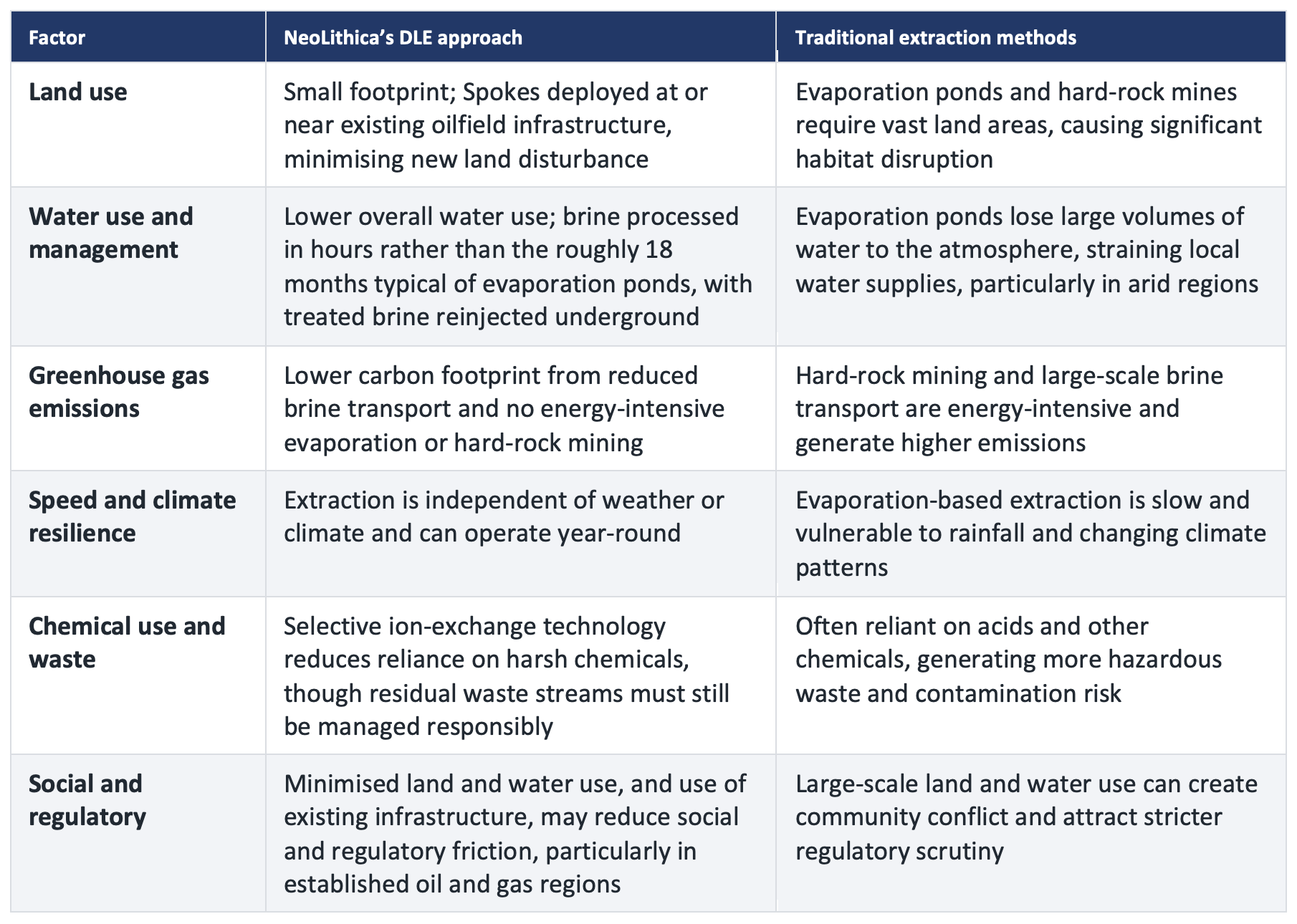
A lower-impact route to lithium
Direct Lithium Extraction differs fundamentally from the two established routes to lithium production — hard-rock mining and solar evaporation ponds — in land use, water consumption, emissions and speed. The principal trade-off is the need to responsibly manage the waste streams and materials introduced by the DLE process itself.
— COMMUNITY AND STAKEHOLDERS
Working with the community
NeoLithica has structured its stakeholder engagement to reflect the importance of both Indigenous and non-Indigenous community support to the Project’s long-term success. The Company maintains a dedicated role for government and indigenous relations and has incorporated into its development plan a formal commitment to consult with government, local stakeholders and indigenous communities ahead of commercial development.
That engagement is reinforced at the provincial and federal level through active relationships with Invest Alberta, Emissions Reduction Alberta, Alberta Innovates and Natural Resources Canada’s Critical Minerals Centre of Excellence.
— DEVELOPMENT PATHWAY
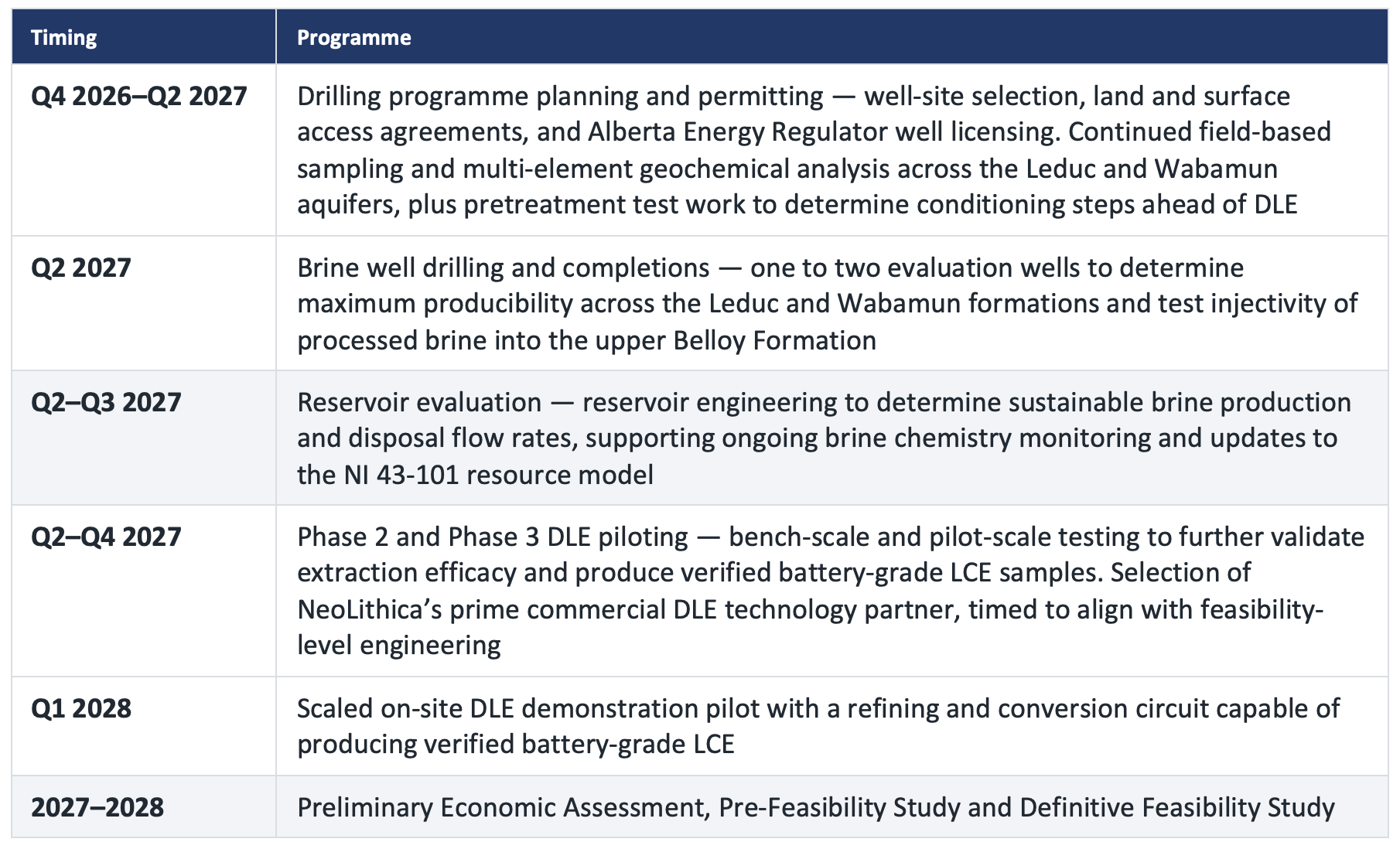
Development pathway, 2026–2028
NeoLithica has structured a development programme spanning late 2026 through 2028, designed to carry Peace River from its current resource-definition and evaluation stage to a construction-ready technical and economic basis, through a staged progression of independent technical studies.
— CLOSING
A multi-generational asset
The Peace River Lithium Project is envisioned as a multi-generational critical mineral asset rather than a single mining operation. Its geographic footprint allows multiple production centres to be developed over time, so that capacity can expand in response to market demand while preserving significant resource inventory for future generations. Based on currently identified resources, the Project has the potential to support production of more than 100,000 tonnes per annum of LCE over a multi-decade operating life.
Against a backdrop of rising global lithium demand, continued supply concentration in Australia, Chile and China, and tightening North American and European policy pressure to diversify critical mineral supply chains, Peace River is positioned to become a significant, stable and geopolitically secure source of battery-grade lithium carbonate for the North American electric vehicle and energy storage industries.
Forward-looking statement
The proceeding contains forward-looking statements and information, including projections of resource volumes, production rates and development timelines. Such statements are based on NeoLithica’s current assumptions, estimates and expectations, and are subject to significant risks and uncertainties, many of which are beyond the Company’s control. Actual results may differ materially from those expressed or implied. Mineral resource estimates referenced on this page, including the Peace River Project’s NI 43-101 inferred resource, are estimates only. An inferred mineral resource has a lower level of confidence than an indicated or measured mineral resource, and there is no certainty that further exploration will result in its upgrading to a higher category. Nothing on this page constitutes an offer to sell, or a solicitation of an offer to buy, any securities, or investment, legal or tax advice.